
An Integrated Community and Partnership Strategy to Safeguard South Misool’s Coral Reefs from Real Threats
RAJA AMPAT – South Misool is more than just a point on the map. For the world, it is the heart of marine biodiversity, home to some of the richest coral reefs on the planet. But for the people of Yellu, Dabatan, and surrounding villages, these waters are a vital source of life that is becoming increasingly vulnerable. Amid the growing threats of illegal fishing and climate change, Yayasan Misool Ekosistem Regenerasi (YMER), through the support of the Blue Abadi Fund (BAF) Primary Cycle 5, has demonstrated that protecting paradise cannot be achieved through a single approach alone.
From December 2024 to August 2025, YMER carried out a large-scale ecosystem protection initiative built upon three key pillars: Strict Surveillance, Science-Based Restoration, and Education for the Next Generation.
A Fortress Built on Patrols and Traditional Wisdom
Rich seas inevitably attract exploitation. YMER’s report presents figures that are both alarming and reassuring: over the past nine months, a total of 840 patrol missions were conducted. The Sea Ranger teams stationed at Daram, Kalig, and Yellit posts worked tirelessly day and night.
The results were significant. A total of 206 violations were successfully addressed, revealing the harsh realities faced in the field: 155 cases of illegal fishing within No-Take Zones, 47 violations within Sasi areas, and 4 cases of destructive fishing practices.
Yet physical enforcement alone is not enough. YMER has strategically embraced local wisdom as part of its conservation approach. The traditional “Buka Sasi” practice implemented between late 2024 and early 2025 resulted in a sustainable fish harvest of 5,542 kilograms. This proves that conservation does not hinder economic livelihoods; instead, it ensures that the ocean’s “savings account” continues to grow and can be harvested responsibly over time.
Hope Growing Beneath the Sea
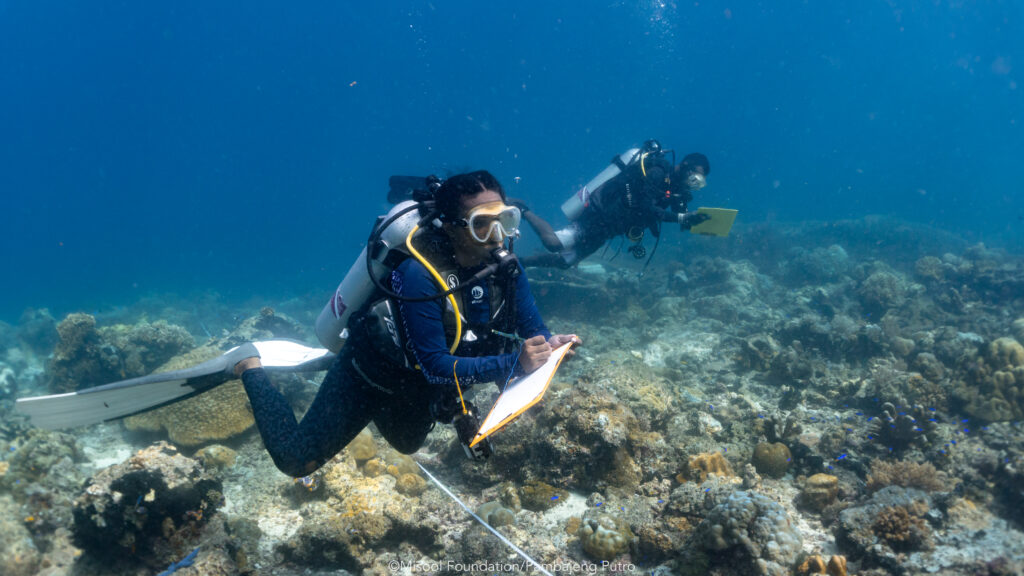
At a time when coral bleaching has become a global threat, YMER chose not to surrender to circumstance. Its coral reef restoration program goes far beyond ceremonial planting activities — it is grounded in rigorous scientific data and monitoring.
On Kalig and Yellit Islands, more than 6,900 coral fragments were transplanted using the Spider Web and Coral Nursery methods, including 4,304 fragments in Kalig and 2,599 in Yellit. Most remarkable is the program’s success rate: transplanted corals achieved a survival rate of 91–97 percent.
This achievement would not have been possible without the dedication of local youth. Through intensive On-the-Job Training, young people from Yellu and Dabatan are no longer only fishermen — they have become “coral doctors,” equipped with skills in coral transplantation techniques and reef health monitoring. They now stand on the frontlines, ensuring that their underwater forests can flourish once again.
Investing in People
Perhaps the least visible, yet most impactful long-term achievement lies within classrooms. YMER understands that the future guardians of the ocean are the children sitting in schools today.
Its Environmental Education Program (PLH) has expanded significantly. No longer limited to senior high school students, the initiative now also engages junior high school students. A total of 333 students — 167 boys and 166 girls — across five schools are now learning about the global significance of their marine environment. Their education extends beyond classrooms through field trips that allow them to witness coral restoration efforts firsthand.
Challenges That Remain
The path of conservation is never easy. Beyond coral reef restoration, YMER is also actively involved in sea turtle conservation efforts. The death of a green sea turtle in February 2025, suspected to have been caused by digestive complications potentially linked to plastic waste, served as a harsh reminder that major challenges still persist. Extreme weather conditions and strong southern winds also frequently force patrol teams to suspend operations, creating opportunities for violations to occur.
Even so, hope remains alive. A total of 1,267 turtle hatchlings were successfully hatched and released back into the ocean, achieving an impressive 89 percent success rate.
What YMER is doing in South Misool teaches us an important lesson: effective conservation is built upon a combination of strong law enforcement, scientific dedication, and sincere investment in people. As long as these three elements continue to work hand in hand, Misool will remain a jewel — not only for Papua, but for the world.
