
Blending local wisdom and village law for sustainable conservation in Tambrauw
TAMBRAUW – In Tambrauw Regency, Southwest Papua, known as the "Conservation Regency," protecting nature is more than just a slogan. To the people of Kampung Nanggouw, Sausapor District, nature is the "mama" that provides life. However, amidst the challenges of climate change and the threat of environmental degradation, local wisdom alone is sometimes insufficient. It requires a "firmer fence" in the form of written law.
This is exactly what the Toweuw Ecotourism Group has undertaken throughout 2025. With funding support from the Blue Abadi Fund (BAF) Innovation Grant Cycle 5, they have proven that effective conservation is a blend of real action in the field ("the hoe") and the struggle for legality ("the paper").
Legal Fences for the Future
This activity began in January 2025. Realizing that threats to their forests and seas were becoming increasingly real, the Toweuw Group facilitated a socialization program on nature protection involving 140 residents from four villages: Nanggouw, Jokte, Sorauw, and Uigwew.
This initiative was not just an ordinary meeting. It was the first step in drafting a Village Regulation (Perkam) on the Protection and Management of Natural Resources. Why is this important? Because historically, customary rules (adat) were often unwritten, making them vulnerable to violation by outsiders.
The process was democratic and participatory. From August to September 2025, the community did not sit idly by. From traditional leaders, women, and youth, to the Village Deliberation Body (Bamuskam), everyone was intensively involved in Focus Group Discussions (FGD) to draft the academic manuscript.
The culmination occurred on September 5-7, 2025, during a Public Consultation attended by 36 representatives. Sixteen parties signed the Minutes of Agreement, a symbol that all elements of society, government, customary leaders, and religious figures, were of one voice to protect their forests and seas through formal law. Now, the document is ready for evaluation by the Legal Bureau of the Tambrauw Regional Secretariat, one step away from becoming binding positive law.
Real Action Caring for the Coast
However, the Toweuw Group was not only occupied with administrative matters. In the field, they wielded hoes to restore the "face" of the village which had begun to erode.
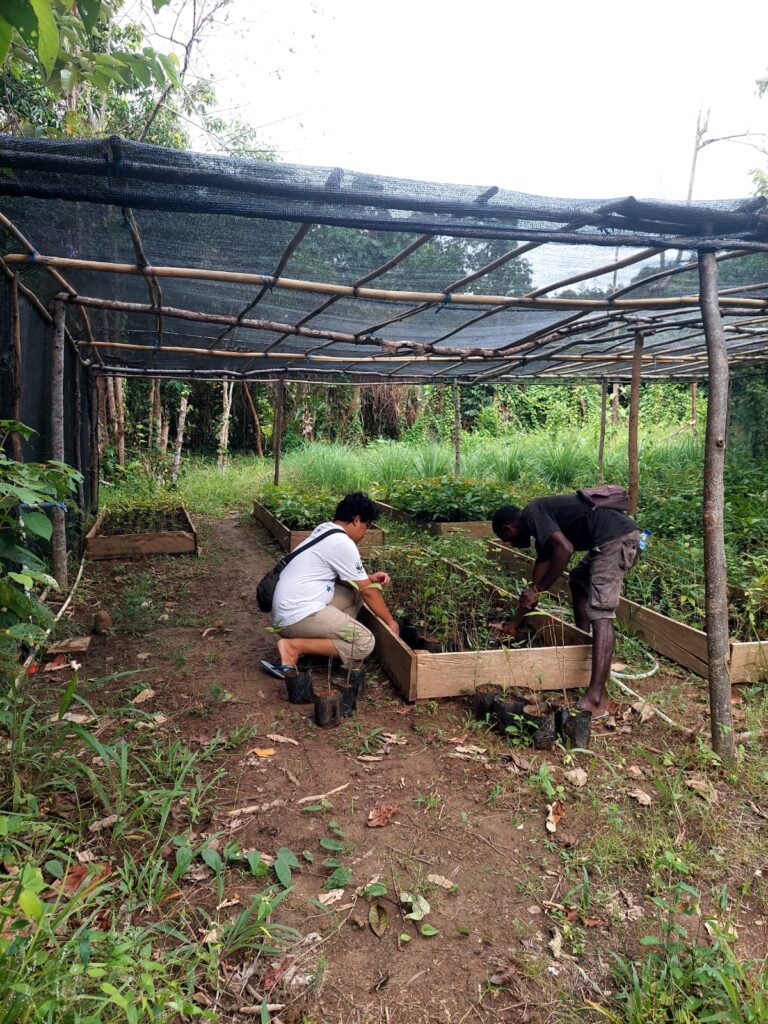
In February 2025, a massive restoration action was carried out on the banks of the Wesan River and the Nanggouw coast. Twenty-eight residents worked together to plant 150 bamboo seedlings, 100 Ketapang (Sea Almond) seedlings, and 50 coconut seedlings over an area of approximately 1,300 square meters.
The choice of these plants was not without reason. Bamboo on the riverbanks serves to hold back landslides and floods, while Ketapang on the coast acts as a natural fortress against abrasion and sea winds. This is nature-based disaster mitigation that is low-cost, effective, and involves full citizen participation, from youths to mothers.
Independence Through Ecotourism
What is happening in Kampung Nanggouw is an ideal model of how indigenous communities can be empowered. The Toweuw Ecotourism Group does not move alone; they embrace local wisdom as their foundation.
The Perkam being drafted is not meant to restrict, but to guarantee that natural tourism assets, such as the Birds of Paradise and the beauty of the coast—remain preserved so they can be enjoyed by children and grandchildren while becoming a source of a sustainable economy. The story from Nanggouw teaches us one thing: Conservation is not just about planting trees, but also about planting awareness and enforcing the rules of the game. With "paper" (Perkam) in one hand and a "hoe" (restoration) in the other, the people of Nanggouw are rewriting their future—a future that is green, sustainable, and sovereign.
