
Strengthening the customary legal umbrella so coastal communities can be sovereign over their nature.
SORONG – In the land of Papua, forests and seas are not merely economic assets; they are "mothers" that provide life, as well as an identity inherently attached to the Indigenous Law Communities (MHA). Yet, an irony often persists: those closest to nature are frequently the most marginalized in decision-making.
Throughout January to August 2025, Yayasan Bentang Alam Papua (YBAP), with support from the Cycle 5 Blue Abadi Fund (BAF), Innovation Grant Cycle 5, has moved to break this silence. Their mission is clear: to provide a sturdy legal umbrella for indigenous communities to manage marine and forest resources sustainably. The final report of this program is not just a sequence of numbers, but a track record of the struggle to restore sovereignty to the owners of customary rights (hak ulayat).
Cries from the Grassroots: "Our Laws Are Ignored"
YBAP’s journey began with listening. On February 4, 2025, during a meeting with the Indigenous Community Institution (LMA) in Sorong, old wounds were exposed. The primary issue that surfaced was the disharmony between national law and customary law. Natural resources are exploited without meaningful involvement, while local wisdom is increasingly eroded by the times.
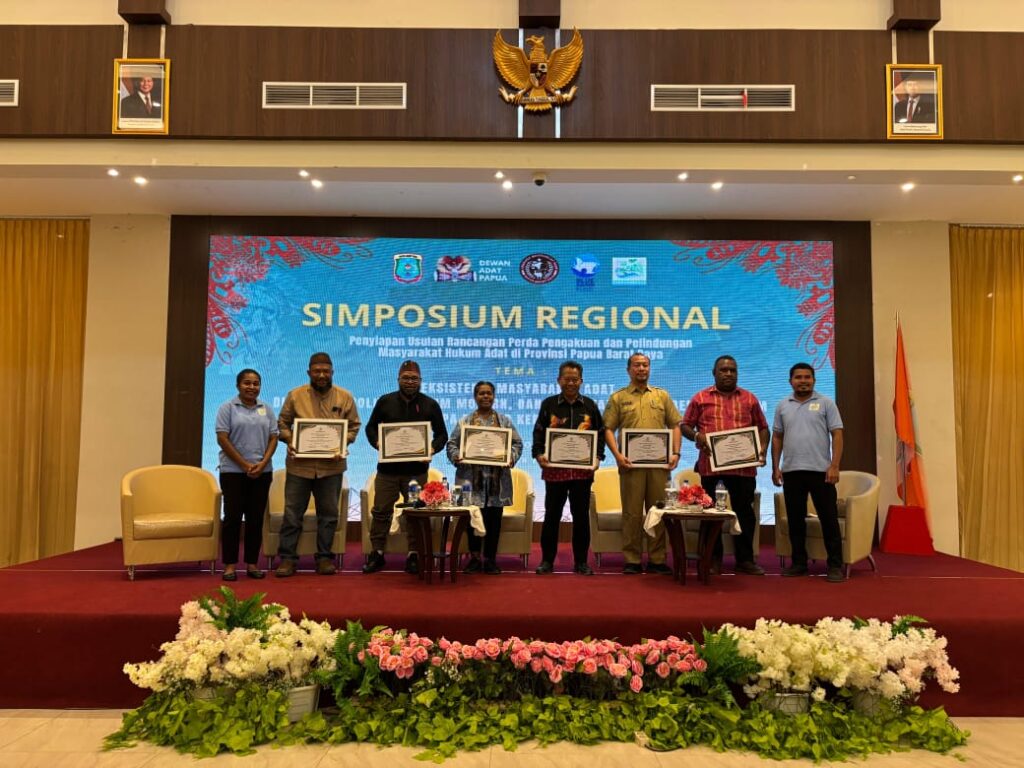
Responding to this, YBAP did not remain silent. They held a Regional Symposium on February 18, 2025, in Sorong City. This forum was not a mere ceremony; it presented 153 participants (115 of whom were Indigenous Papuans/OAP), ranging from the Chairman of the Papuan People's Assembly (MRP) to academics.
The agreement born from this symposium was fundamental: The necessity of an Academic Manuscript and Customary Territory Mapping as absolute requirements for formal recognition. This was a strategic move to transform customary claims—often considered "abstract"—into undeniable legal data.
Voices from Misool: Fear of Losing Identity
It was not enough to speak only at the elite level; YBAP descended to the last line of defense: the villages of Misool. In April 2025, the socialization of the Draft Regional Regulation (Ranperda) was held in the villages of Fafanlap, Folley, and Tomolol.
The community enthusiasm was extraordinary. A total of 214 people (165 OAP) attended to voice their anxieties. Their message was sharp: "Protect our marine and land customary rights from investment permits we do not consent to." They also voiced deep concerns over the loss of their language and customary rituals if there is no government intervention.
This is where the role of the Ranperda on MHA Recognition and Protection becomes crucial. It is not just a rule, but a final fortress to ensure that modernization does not wipe out the cultural identity and ecological rights of the Misool people.
Political Commitment: The Ball is in the Legislature's Court
The pinnacle of this advocacy was the Indigenous Peoples Jamboree on August 11, 2025. Attended by the Governor, the Papuan People's Representative Council (DPRP), the MRP, and tribal chiefs, the forum affirmed that MHA recognition is the key to regional development.
The Governor of Southwest Papua himself emphasized that indigenous people are the guardians of social harmony and environmental sustainability. This commitment must be guarded. The Drafting Team facilitated by YBAP—consisting of academics, legal bureaus, and customary figures—has worked hard to compile the sociological and juridical framework. Now, the "hot ball" is in the hands of the DPRP to immediately discuss and ratify the Ranperda.
Conclusion: Efficiency for Justice
Managerially, YBAP demonstrated high dedication with a budget absorption reaching 95.86% of the total IDR 160 million grant. This figure reflects that every rupiah was used as effectively as possible to finance this complex dialogue, research, and advocacy. YBAP's struggle teaches us that nature conservation in Papua cannot succeed without recognizing its humans. The Southwest Papua MHA Ranperda is a "paper shield" currently being forged. If this shield is successfully raised, it will protect not only the forests and seas but also the dignity of the humans living within them.
