
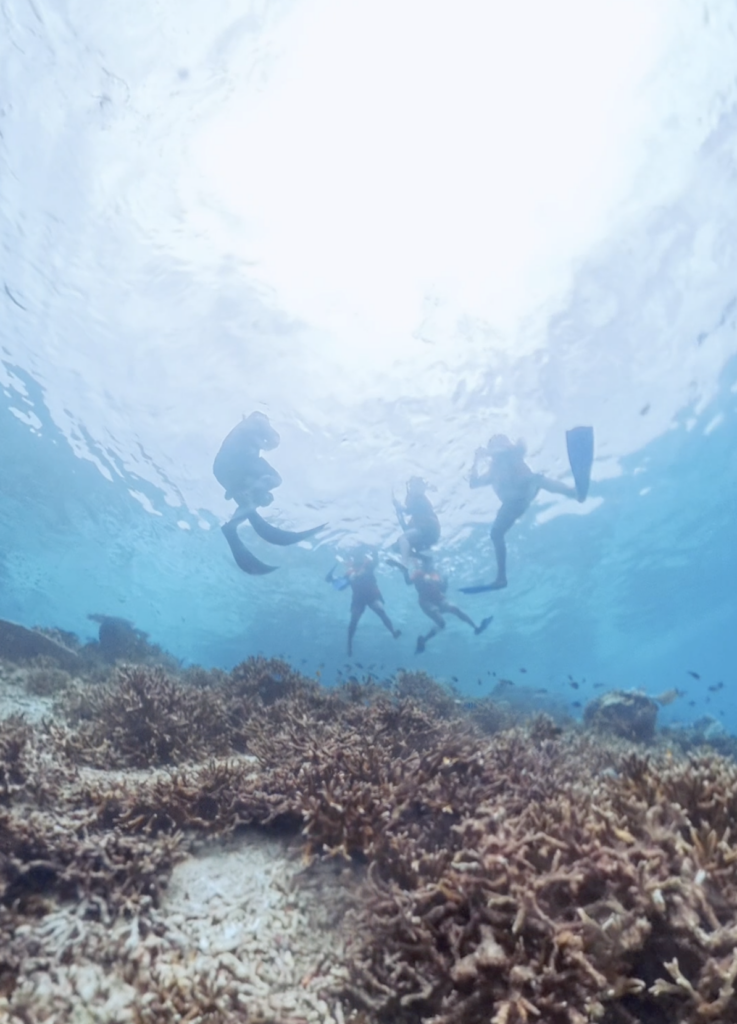
Empowering women divers as the engine of conservation and a sustainable economy in Raja Ampat.
RAJA AMPAT – Behind the fame of Raja Ampat as the world's underwater paradise, there lies a silent yet powerful movement driven by mothers and young women. Historically, marine conservation and natural resource management have often been viewed as a masculine domain. However, the Molobin Women Divers Association (MORA) of Raja Ampat is proving otherwise.
With support funding from the Blue Abadi Fund (BAF) Innovation Grant, Cycle 5, from January to October 2025, MORA has shifted the paradigm for coastal women in Kampung Friwen, Yenbeser, and surrounding areas. They are no longer mere spectators on the shoreline, but key actors turning the wheels of a green economy and guarding the fortress of the marine ecosystem.
From Kitchen to Market: The Coconut Oil Revolution
In Kampung Friwen, economic transformation began with something closest to daily life: coconuts. The "Bin Friwen" women's group, which previously only processed coconuts traditionally, has now leveled up. Through intensive mentoring, they successfully produced 25,000 ml of high-quality organic liquid soap.
This is not just a hobby. With a turnover reaching IDR 10,000,000 from the sale of 100 bottles, their products have penetrated the tourism market, from resorts in Waiwo to the Sorong Nature Tourism Park. This success proves that with proper financial management—from cash recording to calculating the Cost of Goods Sold (COGS)—indigenous women are capable of financial independence without over-exploiting nature.
Women Manta Rangers: Science-Based Ocean Guardians
MORA did not stop on land. Beneath the ocean's surface, new heroines were born, known as "Women Manta Rangers."Sixteen women from Kampung Arborek, Yenbeser, and Yenbekwan have been certified to perform tasks that have long been dominated by men.
Armed with training in the MARS (Mars Assisted Reef Restoration System) method and marine biological identification, 100% of participants are now able to identify coral species and fish, and independently perform coral transplantation. Their presence breaks the stigma that women lack the technical capacity for ecosystem rehabilitation. They are proof that inclusive conservation yields broader impacts.
Securing a Place in the Realm of Sasi
One of MORA's most significant cultural breakthroughs is its intervention in the "Sasi" tradition—the customary system of opening and closing marine areas. In Kampung Yenbeser, women have always understood the rules of Sasi but were frequently absent from decision-making.
Through the "Ocean Class," MORA successfully facilitated the formation of the Yenbeser Village Sasi Women's Group. This is a historic step in providing space for women's voices in customary governance, ensuring that their perspectives on marine resource sustainability are heard and accommodated.
Investing in the Future
The success of this program is also reflected in the efficiency of fund management, which reached a 99.11% absorption rate, signaling the high commitment and professionalism of the team in the field. However, MORA's greatest investment lies in the 462 students across 6 schools who have now been exposed to environmental education. They are the ones who will eventually pick up the baton to guard the paradise of Raja Ampat. The story of MORA serves as a reminder that successful conservation cannot run on one leg. It requires synergy between the economy (organic soap), science (coral rehabilitation), and culture (Sasi). And standing tall at the center of that synergy are the resilient women of Raja Ampat.
