
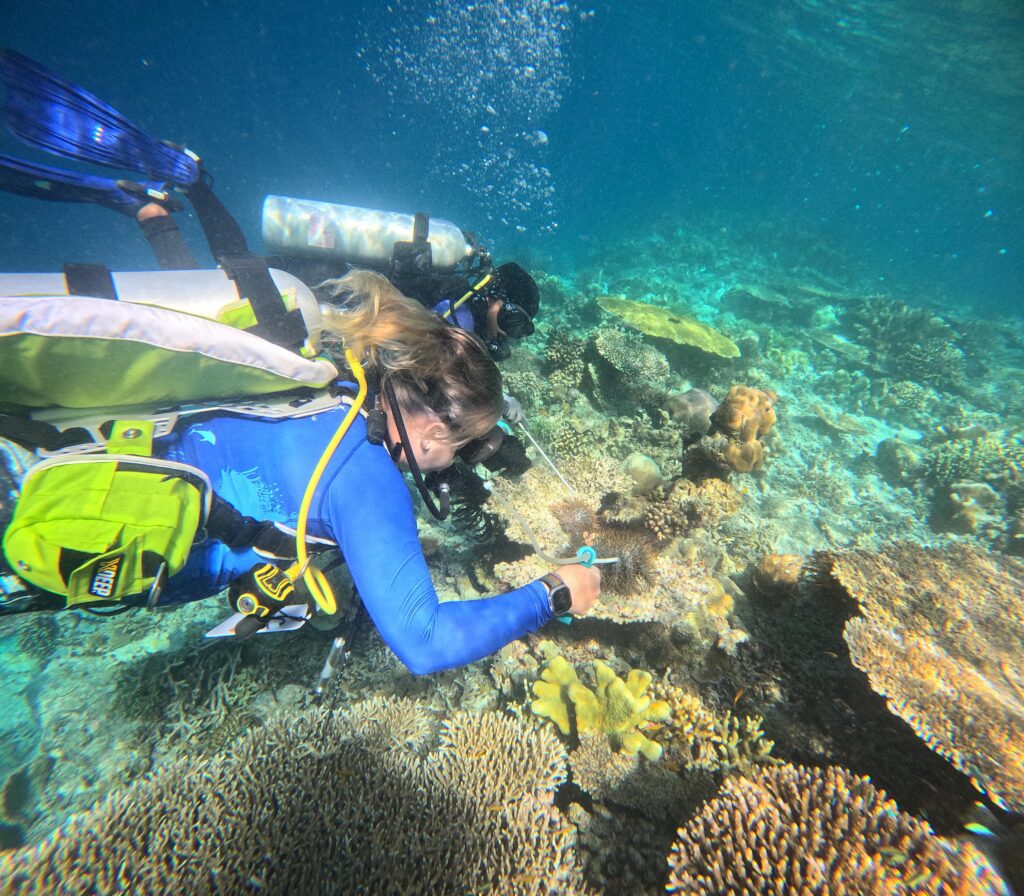
A collaboration between the Yenbekwan community and the Orang Laut Papua Foundation nurtures coral reefs as a tangible response to the climate crisis.
RAJA AMPAT — We often hail Raja Ampat as the last paradise on earth, the beating heart of the World Coral Triangle. Yet, behind the crystal-clear blue waters that grace postcards lies a fierce battle for survival. In Kampung Yenbekwan, along the Dampier Strait, the Orang Laut Papua Foundation (YOLP), together with the local community, is proving that coral reef restoration is not merely a ceremonial planting activity, but an adaptive defense strategy against a very real climate crisis.
Supported by the Blue Abadi Fund (BAF) Innovation Grant, Cycle 5, YOLP’s program opens our eyes to the fact that marine conservation today faces a double threat: the pressure of human activity and the wrath of nature itself.
When the Ocean Has a "Fever" and Strategies for Survival
The year 2025 has been a testing time for Raja Ampat’s waters. The ecosystem was hit by the "dirty water season"—a local term for conditions characterized by warm, turbid, and sediment-filled water. Average water temperatures touched 29-30 degrees Celsius, triggering coral bleaching and an explosion in algae and sponge populations that choke the growth of young corals.
In normal situations, planting as many corals as possible is the main target. However, YOLP demonstrated maturity in conservation management. Instead of forcing mass planting amidst poor water conditions—which risks seedling mortality—the team adapted their strategy. They shifted focus to routine maintenance: removing predators such as Drupella snails and Crown-of-Thorns Starfish (COTs), as well as clearing the algae covering the substrate. A total of 127 COTs and 25 Drupella were successfully eradicated during these cleanup operations.
When planting did proceed, the strategy changed. The team selected stronger species, specifically fragments and genera of Porites and Montipora, as well as some Acropora, while using larger fragment sizes (10–15 cm) to improve survival odds. The result? A beacon of hope: the survival rate of transplanted corals remained stable at 85%, even under severe environmental stress.
Data Speaks: More Than Just Numbers
The quantitative achievements of this program cannot be overlooked. By September 2025, YOLP had successfully restored an area of 3,473 m² across the Rascal Garden, Makor Garden, and Insum sites. This achievement significantly surpassed the initial target of 0.1 hectares (1,000 m²).
By the third quarter alone (up to September 2025), amidst challenges of weather and labor shortages, a total of 9,840 fragments originating from 42 coral types across 23 families were successfully planted. This is no easy task. Every fragment is tied by hand, every meter of wire is deployed at depths of 5–15 meters, and every inch of growth is monitored periodically and input into the logbook on the "My Survey 123" application.
Land-Sea Connection: Addressing Root Problems
A compelling aspect of YOLP's approach is the realization that threats to the ocean often originate on land. Surveys indicated that waste from residential septic tanks had the potential to pollute waters and trigger an increase in COTs presence. In response, YOLP conducted GIS-based mapping surveys of pollution sources in Kampung Yenbekwan and Kurkapa.
Additionally, behavioral challenges—such as fishermen accidentally damaging coral seedlings with fishing hooks—were handled with a humane approach. Education and friendly, family-style reminders were delivered by fellow village youth, building a collective consciousness that destroying coral means destroying their own future "savings."
Transformation of the Sea Guardians
The program's greatest success may not lie on the ocean floor, but in the hearts of the Yenbekwan people. This initiative has shifted the paradigm of local youth. Those who once saw the sea merely as a place to catch fish have transformed into certified "Coral Gardeners." Collaborations with the tourism sector, such as Liveaboard Rascal and Soul Scuba, provide not only material support but also create a new economic model where coral preservation brings tangible economic incentives to the village. The story from Yenbekwan teaches us one crucial lesson: Ecosystem restoration in the era of the climate crisis requires more than just good intentions. It demands robust data, adaptive strategies, and genuine collaboration between communities, scientists, and tourism operators. The corals in Raja Ampat may be suffering from a "fever," but the spirit of their guardians is burning brighter than ever.
